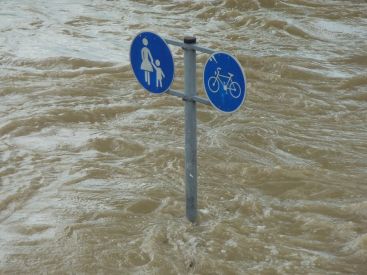
At the start of 2025, several départements are underflood alert. In 2024, Paris broke its rainfall record, a sad performance that worries many private and public players: Paris City Hall is preparing awareness and action plans to train Parisians in the scenario of a major flood on the Seine.
The river that runs through the capital has already given some scares to those who live on its banks. Climate experts are predicting an increase in flooding in the coming years, due to climate change.
To avert such catastrophic scenarios, and prevent widespread damage throughout the Île-de-France region, a number of local authorities (including the Metropole du Grand Paris, the Pays de Meaux urban community...) decided to set up a special body to manage and prevent such high-risk situations. TheEtablissement Public Territorial de Bassin (EPTB) Seine Grands Lacs has therefore built a new reservoir to collect surplus water and lower the level of the Seine during periods of high water, in order to prevent flooding.
Work on the Seine Bassée pilot reservoir began in 2021. Work was completed in 2024, and a flood test was carried out on Monday January 13, 2025, prior to the official commissioning of the 360-hectare basin. This experimental project, installed in the Seine-et-Marne region between the communes of Châtenay-sur-Seine, Balloy, Égligny and Gravon, " consists in building diked areas capable of retaining part of the Seine's water in the event of a major flood, and lowering its level by up to 15 cm depending on the flood and location. "
The basin also includes a pumping station and a 7.8 km-long dike. The Seine Bassée pilot reservoir complements and supports the efforts of the four reservoirs already built to prevent flooding in the Aube, Haute-Marne and Nièvre regions. According to Le Parisien andActu.fr, the project cost 114 million euros.
The monumental reservoir is due to be commissioned soon. On Monday January 13, 2025, the Prefecture and Seine Grands Lacs carried out the first phase of the test. The communes, owners and operators located near the site have received a warning. On Tuesday 14th, they will receive an evacuation order. The following day, the basin will be filled to half its capacity, and the water will remain in storage for two weeks. Then, at the beginning of February, the basin will be filled to capacity, and stored again for 16 days. The water will then be drained, and the site reopened to the public.
At each stage, meticulous checks will be carried out by agents and authorities, to ensure that the devices are working properly. If each inspection is validated, the site can be officially inaugurated.